
Ridge capping is the row of curved or angled pieces that sit along the very peak of a tiled roof, covering the join where two roof surfaces meet. It looks like a small detail, but it does a lot of the work in keeping wind and rain out of a roof’s most exposed point.
What Is Ridge Capping?
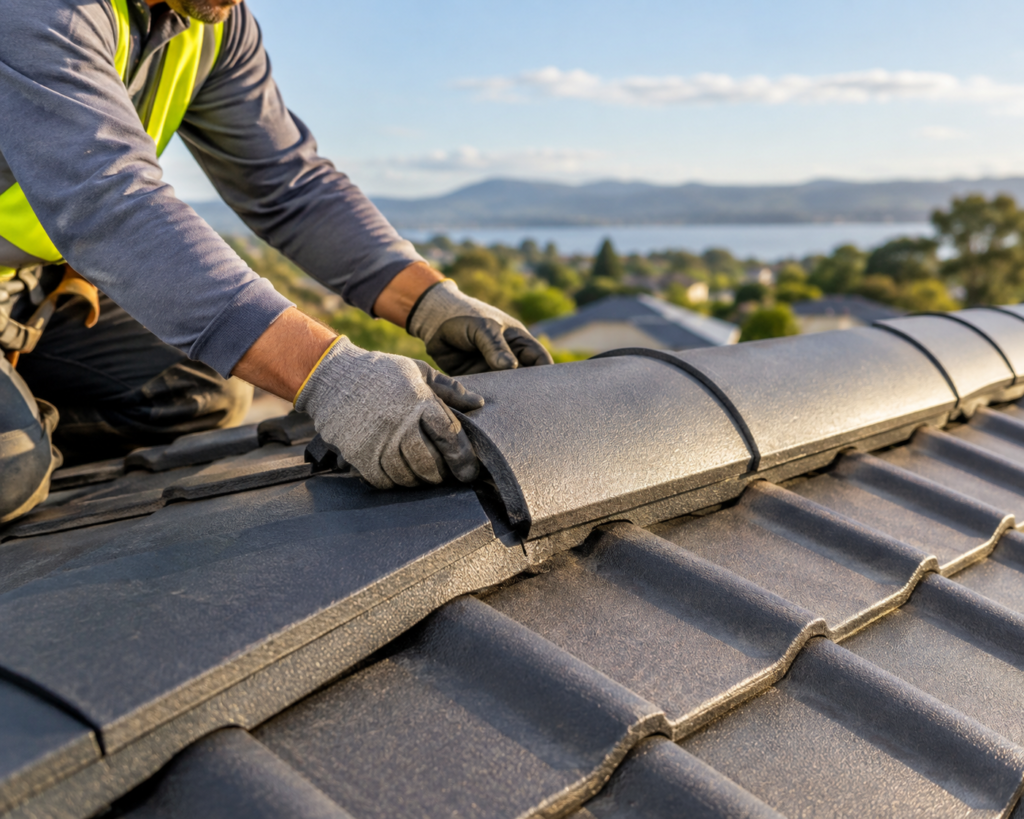
Ridge capping refers to the tiles or capping pieces that run along the ridge line, which is the highest point where two sloped sections of a roof meet.
Each cap sits over the join, bedded in mortar and sealed along the edges with a pointing compound, forming a continuous, weatherproof line along the roof’s top.
What Is Ridge Capping Made Of?
On most Sydney tile roofs, ridge capping is made from terracotta or concrete, matching the material used for the rest of the roof tiles.
It sits on a bed of mortar or a modern rebedding compound and is finished with flexible pointing, which seals the joint and allows for slight movement without cracking. Metal roofs use a different ridge flashing that serves a similar purpose.
What Does Ridge Capping Actually Do?
Ridge capping seals the highest, most exposed line on the roof against wind-driven rain, while also helping tie the two roof planes together structurally.
Without it, the ridge line would be an open gap straight into the roof cavity, making it one of the most important, if least noticed, parts of a tiled roof.
What Are the Signs Ridge Capping Needs Attention?
Common signs include cracked or crumbling mortar along the ridge line, individual caps that look loose, shifted, or slightly raised, and small gaps visible from inside the roof space.
A leak that seems to start near the top of the roof, rather than lower down, is also worth checking against the ridge capping first.
What Causes Ridge Capping to Deteriorate?
Ridge capping sits in one of the most weather-exposed positions on the entire roof, so age, sun exposure, and constant expansion and contraction all play a part over time.
Older mortar-based bedding is also more rigid than modern flexible compounds, which means it is more prone to cracking as the roof naturally moves.
Does Ridge Capping Need Rebedding, Repointing, or Both?
Rebedding replaces the mortar layer underneath the caps, while repointing reseals the visible surface on top. The two are usually done together, since failure in one often leads to failure in the other.
For a small, isolated section, you can handle this as a standalone repair. You can book a ridge capping repair once a roofer has confirmed how much of the ridge is affected.
When Does Ridge Capping Need More Than a Repair?
If individual capping tiles are cracked, broken, or have shifted significantly out of place, rebedding and repointing alone may not be enough to fix the problem properly.
In that case, replacing the affected caps, or addressing ridge capping as part of our restoration process alongside the rest of the roof, is usually the more reliable option.
How Do You Get Ridge Capping Checked?
Ridge capping is easy to overlook from the ground, since it sits at the highest point of the roof and often looks fine from a distance even when the mortar underneath has started to fail.
An annual roof check-up is one of the simplest ways to catch early wear before it turns into a leak, particularly on older homes where the original mortar has had decades to age.
Heritage properties in particular often have traditional capping styles best assessed by our heritage roofing team, who understand how to work with older materials and period-correct techniques.
Ridge capping might be a small part of the roof, but it takes on a disproportionate amount of weather exposure over the years.
To arrange a free inspection or get in touch by phone, we can inspect the ridge line on your roof and confirm its condition.